
Same data, different answer
Sampling is built into a language model. Ask twice, get two answers. A clinical decision can't rest on a coin flip that's invisible to the clinician.
ObGynAssist™ is one clinical companion for obstetrics and gynecology — ten modules, from fetal-growth staging and twin assessment to ectopic workup, thromboprophylaxis and recurrent pregnancy loss — all built on a deterministic engine: the same data always yields the same answer, every threshold traces to a named guideline, and every decision can be audited rule by rule.
A general AI can sound right and still be wrong in ways you can't see. In obstetric and gynecologic clinical decision-making, three failure modes are disqualifying — any one of them on its own.
Sampling is built into a language model. Ask twice, get two answers. A clinical decision can't rest on a coin flip that's invisible to the clinician.
Invented cut-offs, invented citations. Here the cost of a confident fabrication isn't a typo — it's a missed FGR or a mistimed delivery.
When a decision is questioned, you need to know which step fired which rule. A black box can't show its work — and these aren't tuning bugs, they're inherent.
We didn't fine-tune a model. We built a rule engine that turns input into a sourced clinical plan through a fixed seven-step pipeline — and proves it every time.
Not intuition. The same biometry and Doppler produce a byte-identical plan — yesterday, today, and five years from now.
Not guesswork. Each decision names the RCOG, NICE, ISUOG, ACOG or INTERGROWTH-21st reference behind it.
Not opacity. When a plan is questioned, the audit trail shows precisely which step fired which rule.
ObGynAssist spans the OB-GYN day: fetal growth and twins, eight pregnancy-care calculators, and gynecology — each module self-contained, each grounded in its own guideline, all sharing the same deterministic foundation.
FGR / SGA / AGA / LGA staging, Doppler analysis and eight twin pathways.
RCOG · ISUOG · NICE · DelphiDating, ectopic, aspirin & VTE prophylaxis, thyroid, hyperemesis, ASA and CMV.
RCOG GTG · NICE NG · ISUOGEvidence-based workup with APS- and PRISM-gated treatment logic.
ESHRE 2022 · RCOG GTG 17FetalGrowth is where the engine runs deepest — one module spans every size classification and both pregnancy types, and reads a trajectory rather than a single measurement.
Early- and late-onset growth restriction, staged by Doppler.
Appropriate-for-GA, with wellbeing and maternal overlays.
Large-for-GA and macrosomia, diabetes-stratified.
DCDA / MCDA / MCMA with TTTS, TAPS, sIUGR and discordance.
Crossing centiles, accelerating, stagnant, or deteriorating on Doppler — the engine evaluates how growth is moving, not just where it sits today.
No black box. Pick a case and watch it descend the real pipeline — single-field sanity and cross-field plausibility gates, an 80-way routing decision, 445 rules narrowed to the handful that actually fire, a 14-layer coherence pass, then a stamped, replayable plan. Same input, same descent, every time.
A faithful illustration of the real nine-stage pipeline (ClinicalPipeline.evaluate):
stage names, rule IDs and table sizes are the engine's own. Reduced to its skeleton for the web —
the shipping engine weighs many more inputs and modifiers. Not for clinical use.
Measured on the flagship FetalGrowth engine — the same testing discipline backs every module in the app.
runs bit-identical across 50 configurations × 1,000 seeds — determinism, proven.
p95 latency. A full sourced plan computes in real time, on the phone.
guideline reference cards behind 445 rules — RCOG, NICE, ISUOG, ACOG, INTERGROWTH-21st.
Concordance is measured against an independent guideline oracle on synthetic cases — it reflects agreement with standard-of-care references, not neonatal outcomes. A prospective clinical-validation study is in design. Read the full validation →
The most correct engine changes nothing if it can't be used. ObGynAssist puts the engine in a calculator clinicians trust — enter biometry and Doppler, get a staged classification, an acuity label, surveillance timing and the citations behind every line. Shown below in the flagship FetalGrowth module; every module follows the same flow.
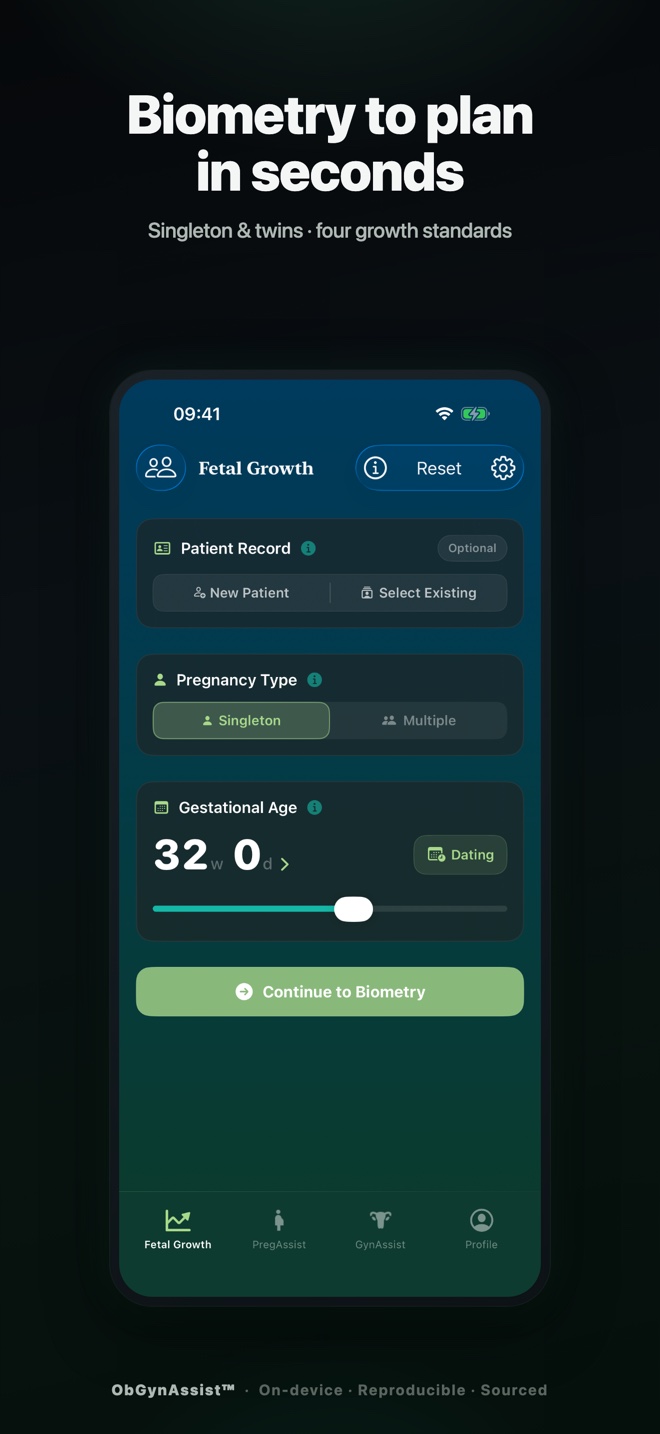
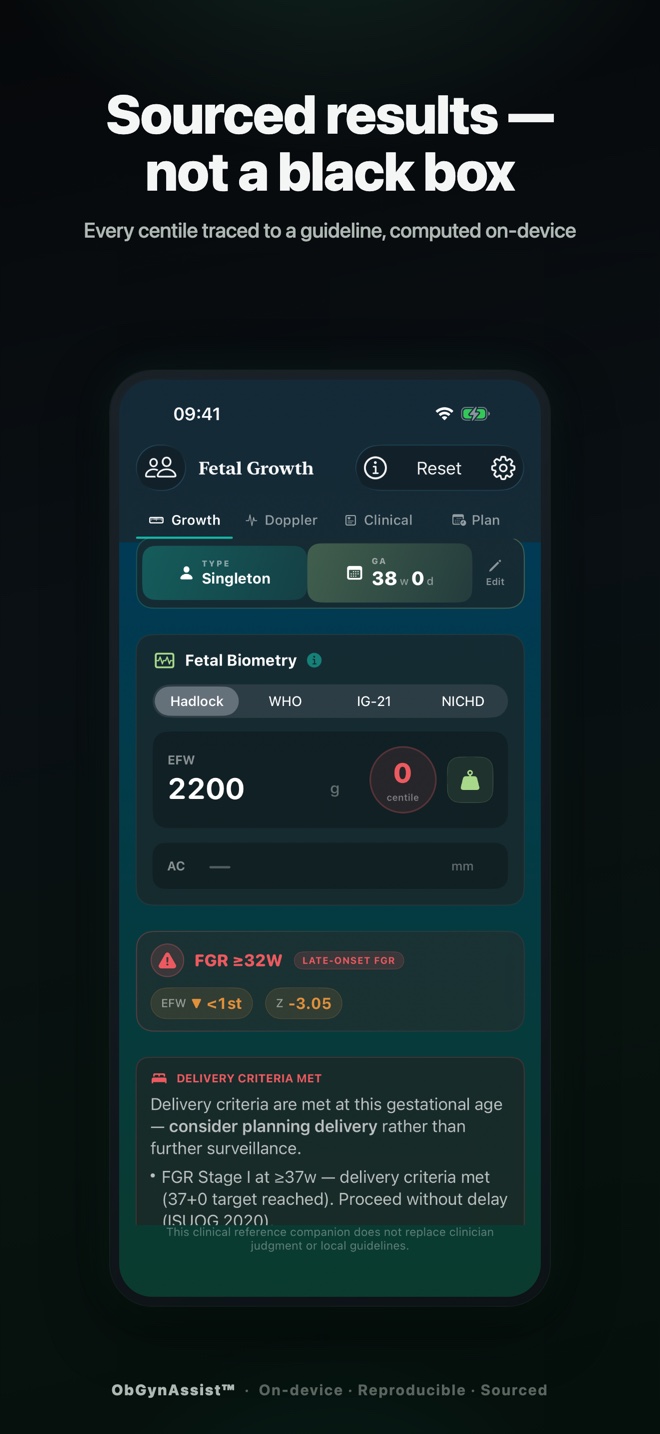
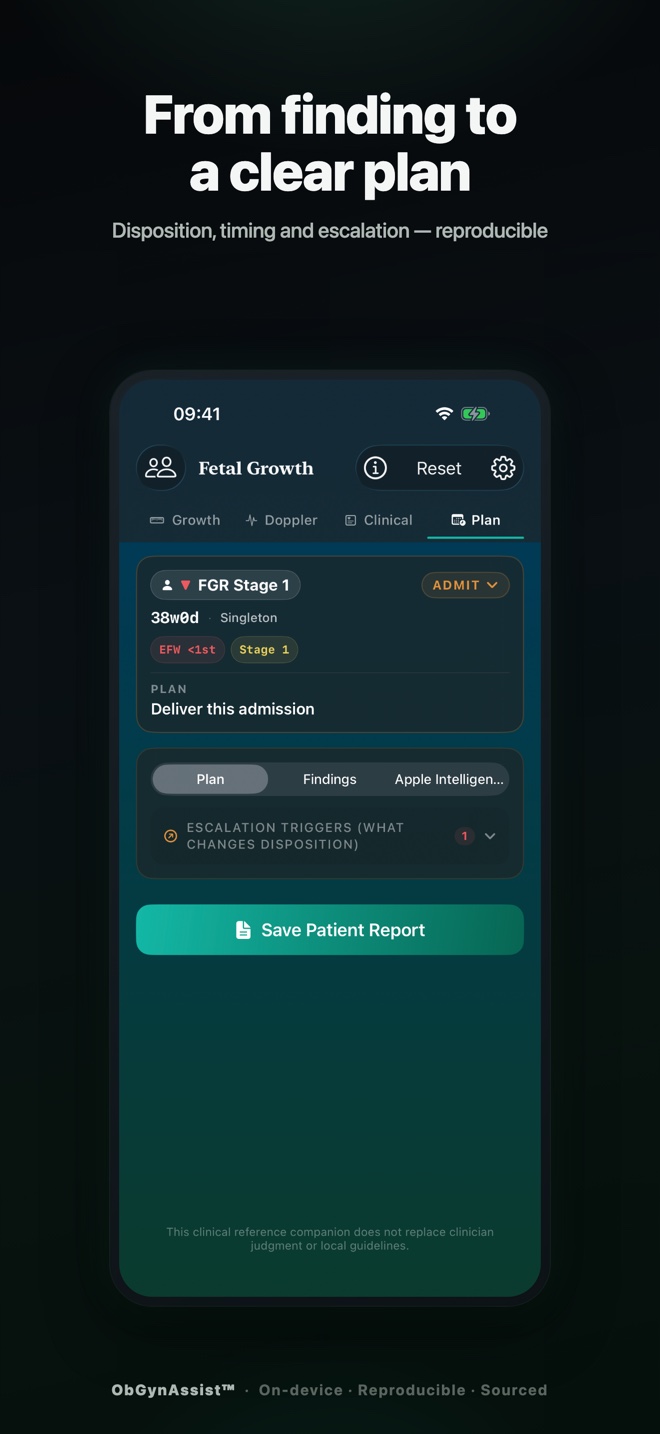
Not faster, not flashier. More reliable, more traceable, more correct. ObGynAssist is coming to the App Store as a Medical Reference companion. For early access or clinical partnership, get in touch.
Or email info@obgynassist.com
Coming to the App Store · Medical Reference